
Disclosure: Pets Life Time participates in affiliate programs. Product links in this article may earn us a commission at no extra cost to you, it helps keep our content free. Learn more
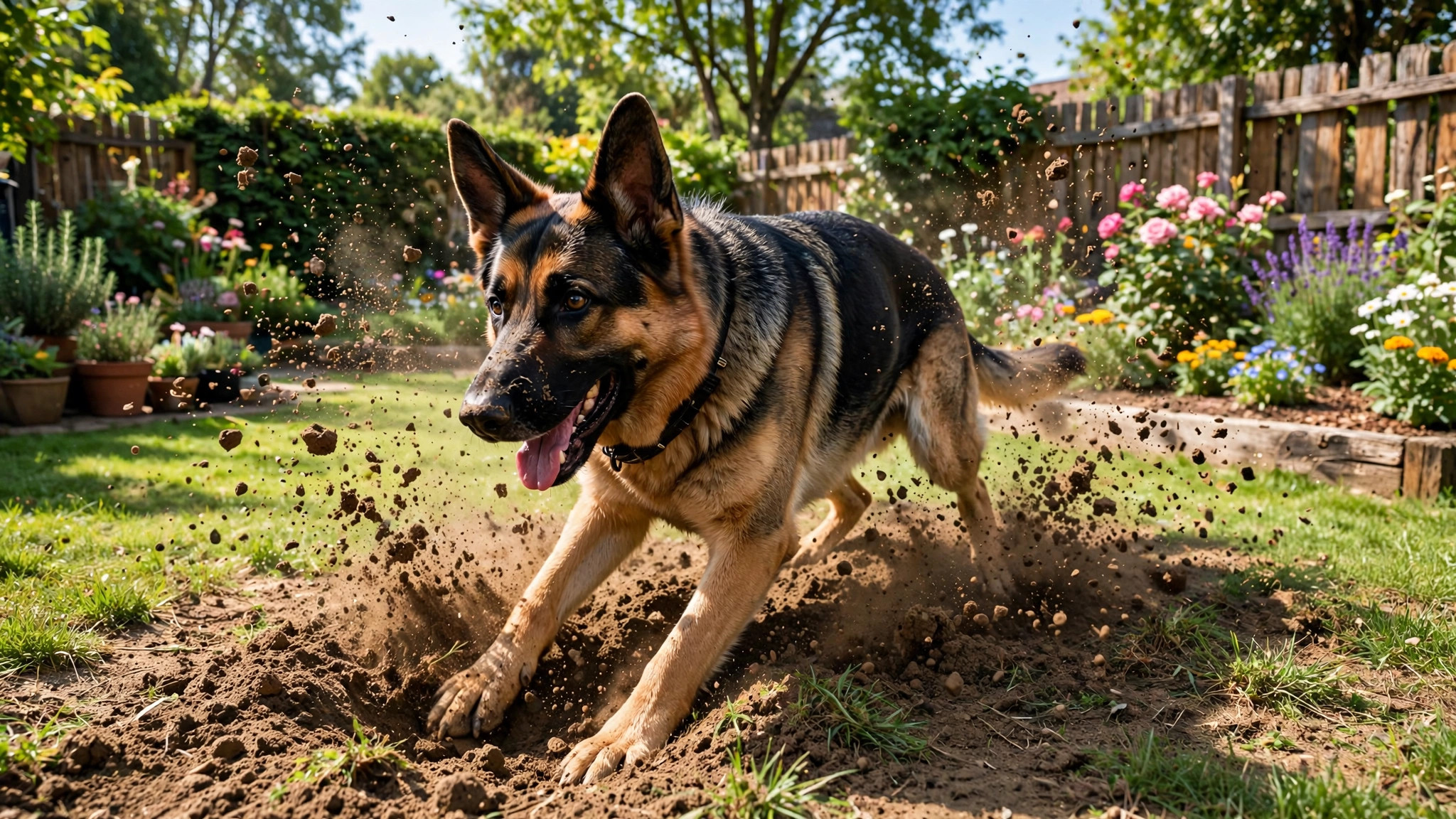
You mow the lawn on Saturday. By Sunday evening it looks like someone took a small backhoe to it: craters by the fence, a trench through the flower bed, and one very pleased German Shepherd with dirt on his nose, sitting in the middle of the damage.
Your dog is not doing this to annoy you. Digging is one of the oldest dog behaviors there is. Wild canids dug dens, buried food for later, and scraped out cool resting spots long before anyone owned a lawn. Your German Shepherd still carries that wiring. The real question is: why is he digging in this spot, right now, and what does he need instead?
Get that answer right and the fix gets a lot simpler. Get it wrong and you spend a whole summer filling holes that reappear in the same places.
Read the Holes First: What the Pattern Tells You
Before you buy anything, spend three days watching. Note where your dog digs, when it happens, and what happens right before. A dog who digs frantically in one spot needs a different fix than a dog who only digs at the gate after you leave. Find the row that looks most like your yard, and start there.
| What you see | Likely reason | First fix to try |
|---|---|---|
| Shallow pits your dog lies in, mostly on hot days | Cooling off | Shade, fresh water, and time indoors during the heat of the day |
| Deep digging along the fence or under the gate | Escape or getting to something on the other side | Supervise yard time, secure the fence line, and never leave the dog alone out there for long stretches |
| Frantic digging in one spot, nose down, ignoring you | Prey underground, like moles or voles | Supervise, reduce the prey attraction, and give a legal digging outlet instead |
| The same hole reopened again and again, toys or bones buried in it | Caching, storing treasures for later | An approved digging pit, and fewer high value toys left outside unsupervised |
| Digging at doors or gates only when you leave, plus barking or house soiling | Separation anxiety | Talk to your vet or a behaviorist, and work on gradual departures, not punishment |
| Random craters all over, worst in the evening or after a dull day | Boredom and unspent energy | More exercise, training, and food puzzles before yard time |
| Short bursts of digging, then running off to play | Play and exploration, common in puppies | An approved pit and a redirect to a game every time |
Most dogs mix two reasons. A bored Shepherd might start digging out of restlessness, then keep digging because he caught a scent underground. Pick the reason that shows up most often. If digging drops by half in two weeks, you picked right.
7 Reasons Dogs Dig, Explained Plainly
1. It is built in
Some behaviors need no training at all. Digging is one of them. The American Kennel Club explains that digging goes back to dogs’ wolf ancestors, who dug dens for shelter and buried food to come back to later. Terriers were bred to go after animals underground, so their drive runs especially hot. German Shepherds were bred to work all day with their noses and brains. A dog built for work will find work to do. If you do not give him a job, digging is a very available one.
2. Boredom and a full tank of energy
This is the most common reason in pet homes. A German Shepherd left alone in a yard is not exercising himself. He is standing in a yard. He might trot around for ten minutes, then lie down, or he might start a project. Digging is physical, it uses his nose, and it feels good, which is why it repeats.
The fix is not just a longer walk. A tired body with a bored brain still digs. Pair the walk with training and a food puzzle or scent game. Our guide to how much exercise a German Shepherd needs daily breaks down realistic amounts by age.
3. Something is moving down there
Dogs hear and smell things we cannot. VCA Animal Hospitals notes that dogs can pick up high frequency sounds and scents from voles and moles beneath the ground, and that alone can start some dogs digging. Prey digging is focused and aimed at one spot, not wandering around making holes.
Prey driven digging is the hardest kind to train away with treats alone, because the prey itself is the reward. Management matters more: supervise yard time, and check whether grubs or moles are drawing animals in. If you treat the lawn for grubs, follow the label exactly and keep your dog off it for the stated time.
4. Cooling down or getting comfortable
Freshly turned earth is cooler than the surface on a hot day, and a shallow pit lets a dog press his belly against cool soil. German Shepherds feel this more than some breeds because of the double coat, which insulates well in winter but holds heat in summer. A dog who digs a hollow and lies in it, stretched out and relaxed, is air conditioning himself.
Give him a better version: shade, fresh water that does not tip over, and access indoors when it is hot. A kiddie pool in the shade works for many Shepherds too. Try it supervised first.
5. Burying treasures
Caching is the polite word for it. Your dog gets a bone or toy, decides it is too valuable to leave lying around, and buries it. Then he digs it up later, like showing off a savings account. Dogs who cache tend to reopen the same holes.
This is the easiest digging to redirect, because you can give it a legal address. A digging pit lets a caching dog keep the ritual without wrecking the garden. Stop leaving high value chews outside unsupervised. Save those for indoors.
6. Trying to escape
Fence line digging deserves attention fast, because it is a safety problem, not just a lawn problem. A dog who learns he can dig under a fence will use that skill again. Dogs dig to escape to reach something interesting, another dog, or just to roam. Sometimes the trigger is a female dog in heat nearby, which no training fully overrides. Secure fencing is worth discussing with your vet for a roaming dog, though neutering alone does not cure digging.
Walk the fence line yourself. Look for soft soil, gaps under gates, and spots where the fence meets a slope. Buried wire mesh or pavers along the base, with no sharp edges sticking up, can slow a digger down, but the real fix is supervision.
7. Anxiety, and the need for attention
An anxious dog digs differently. The digging often clusters around exits: doors, gates, the fence nearest the street. It often comes with other signs, like barking, pacing, or house soiling, and it often starts soon after you leave. Cornell University College of Veterinary Medicine notes that fearful dogs may dig at doors and attempt to escape when scared, for example during fireworks or thunderstorms. That is panic, not misbehavior, and scolding a panicking dog makes it worse.
Separation related digging needs a different plan, and it sometimes needs professional help. Our guide to German Shepherd separation anxiety walks through gradual departures and the signs that mean it is time to call your vet or a behaviorist. If digging started suddenly in an older dog, or comes with limping or eating dirt, book a vet visit first. No training plan fixes a medical cause.
Attention digging is milder. Some dogs learn that digging brings their owner running outside, even if the owner is shouting. To a bored dog, shouting is still attention. Interrupt calmly, redirect, and praise the calm behavior that follows.
What Not to Do
Three mistakes make digging worse. First, punishing after the fact. If you come home, find a crater, and scold your dog, he does not connect your anger to the hole he dug an hour ago. He connects it to you coming home. VCA warns that blocking all digging without dealing with the reason can push the behavior elsewhere, like chewing or barking.
Second, harsh deterrents. Skip cayenne pepper, hot sauce, and concentrated essential oils in holes. They can irritate eyes, noses, and skin, and a determined dog will often dig right next to the treated spot anyway.
Third, expecting zero digging. The AKC is blunt: it is extremely difficult to stop a dog from being a dog. A realistic goal is no digging in the wrong places, with plenty allowed in the right place.
The 14 Day Plan That Actually Works
This plan is built around one idea: make the wrong places boring and hard to practice in, and make one right place very rewarding. Two weeks is enough to see real change for boredom, caching, and play digging. Anxiety and prey digging take longer. Judge the plan by direction, not perfection.
Days 1 to 2: Watch and write it down
Keep a simple log: time, spot, and what happened just before. Two days of notes will often name the reason better than any article can. While you watch, stop leaving your dog unsupervised in the yard for long stretches.
Days 3 to 4: Fix the energy gap
Add one training session and one enrichment activity each day before yard time: ten minutes of obedience, a food puzzle, or a scent game. Our puppy training schedule shows how to stack short sessions. If you use many training treats, our dog calorie calculator helps check portions.
Days 5 to 7: Build the digging pit
Pick a corner away from fences and flower beds. Fill a low sided sandbox with sand and loose soil, keep it damp, and bury a few toys and treats just under the surface. Walk your dog to it on leash and let him find them. Praise him well.
Repeat that seeding for a few days. Stay nearby, reward pit digging, and calmly redirect other digging back to the pit.
Days 8 to 10: Teach the redirect
When he digs in the wrong place, interrupt with a calm, cheerful sound, not a shout. The moment he looks at you, call him to the pit or start a game, and reward him. The AKC recommends exactly this kind of redirect.
Practice “leave it” indoors too, starting with boring objects. Keep sessions to five minutes.
Days 11 to 14: Proof it and protect the yard
Now test the plan in harder settings. Let your dog into the yard at a time he used to dig, and watch from a chair. Reward calm behavior and pit digging. Also fix the fence line, block off flower beds, and fill old holes.
By day 14, ask: is digging less frequent, is more of it in the pit, and is your dog calmer in the yard? If two answers are yes, keep going. If nothing changed, recheck the table. You may be treating boredom when the real reason is anxiety.
Recommended Gear for Digging Dogs
Recommended
KONG Classic Durable Natural Rubber Toy (Large)
Stuff it with kibble and peanut butter and freeze it overnight. It gives a bored digger a long, legal job.
Check Price on AmazonRecommended
Snuffle Mat for Dogs
Scatter kibble through it and let your dog forage indoors. It burns mental energy on rainy days.
Check Price on AmazonRecommended
Step2 Play and Store Sandbox
A ready made digging pit with a lid. Fill it with sand and soil, bury a few toys, and your dog has a legal place to dig.
Check Price on AmazonYard Checklist: Before You Leave Your Dog Outside
Run through this list until it becomes habit. It takes about a minute.
- Fence and gates checked, no new gaps or soft spots at the base
- Fresh water out, in a tip-proof bowl
- Shade available, or dog comes inside in the hottest hours
- High value bones and toys brought indoors
- One food puzzle or long lasting chew ready for yard time
- Digging pit seeded with a toy or a few treats
- Flower beds and vegetable patches blocked off or fenced
- Yard time supervised if mole or vole activity is active
- Dog exercised or trained earlier in the day
- Time outside kept short and supervised until the habit is under control
Frequently Asked Questions
Can you train a dog to stop digging completely?
For most dogs, no. Digging is normal, so the realistic goal is to move it to an approved spot and remove the reasons for digging in the wrong spots. A dog who digs happily in his pit but leaves the rest of the yard alone has learned the lesson that matters.
Why did my dog start digging all of a sudden?
Sudden digging usually has a trigger: a new animal in the yard, a change in routine, hotter weather, or a recent move. In older dogs it can also signal pain, so a vet check is worth it if the change is abrupt and comes with other new behaviors.
Why does my dog dig under the fence?
Usually to reach something on the other side, or to get out of a boring or stressful yard. Treat it as urgent: a dog who gets out once will try again. Supervise yard time and secure the fence base.
Why does my dog bury his toys and then dig them up?
That is caching, an old survival behavior. Wild canids buried food for lean times. Give him a digging pit where caching is allowed, and keep valued toys indoors.
Is digging bad for my dog’s health?
Digging itself is good exercise, but it has risks: broken nails, cuts from buried objects, parasites from soil, or eating something harmful like fertilizer or treated lawn products. Check paws after heavy sessions, and call your vet if your dog starts eating dirt regularly or vomits after digging.
My dog digs on his bed and on the couch too. Is that the same thing?
Partly. Bed digging is often nesting: scratching and circling to shape a comfortable spot before lying down. It is normal in small doses. If it becomes frantic or comes with restlessness and trouble settling, talk to your vet.
This article is for information only and isn’t a substitute for your vet’s advice. If digging comes with injury, sudden behavior change, or distress when left alone, get professional help sooner rather than later. Most digging problems are fixable: identify the reason first, then give a legal outlet.

Leave a Reply