
Disclosure: Pets Life Time participates in affiliate programs. Product links in this article may earn us a commission at no extra cost to you, it helps keep our content free. Learn more
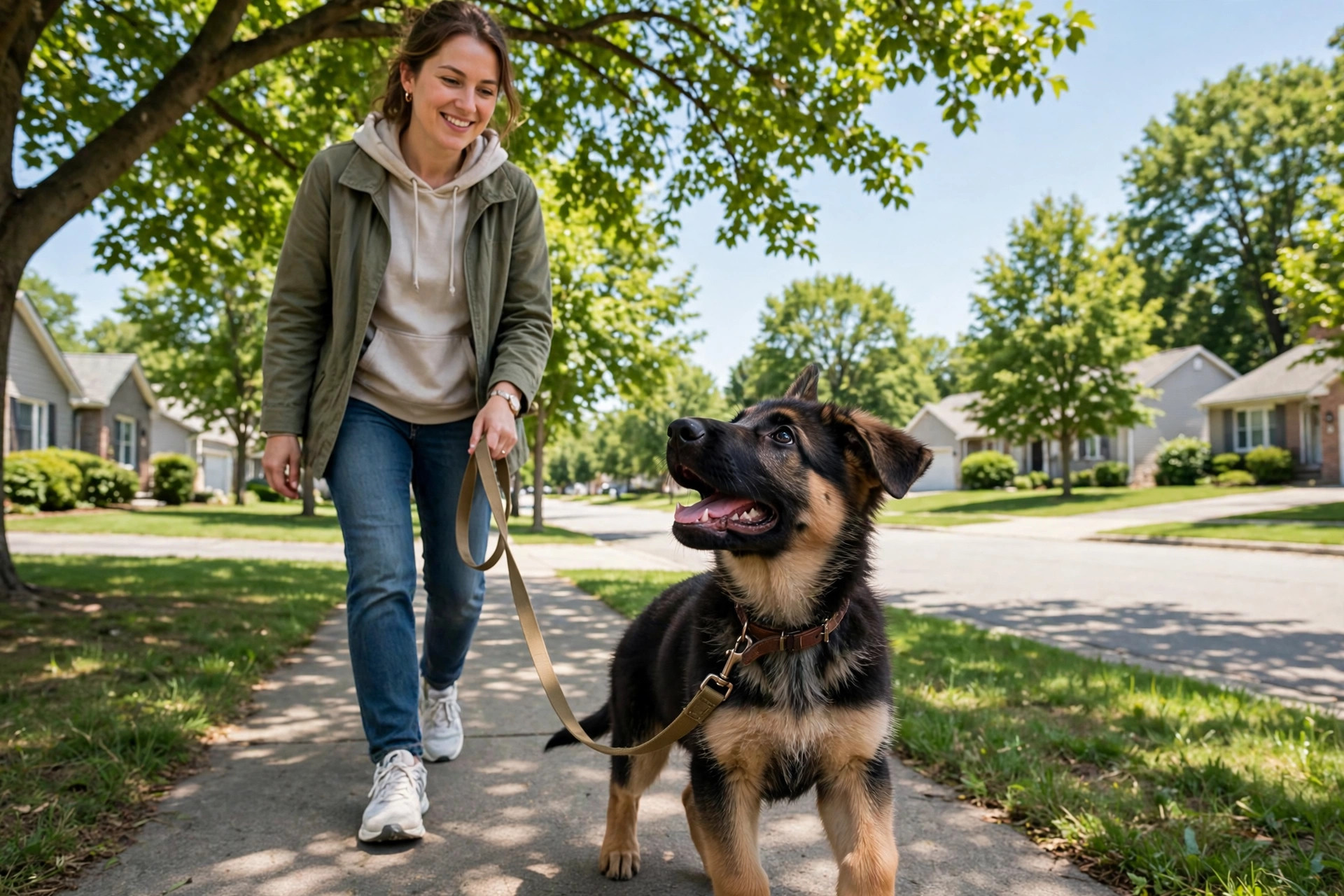
If your first walk with a German Shepherd puppy felt like being towed behind a small, furry speedboat, you are not doing anything wrong. Puppies are not born knowing what a leash is. To them, the thing clipped to their collar is a weird tether, and the whole world smells like it needs investigating right now. Loose leash walking is a taught skill, not a personality trait.
This guide gives you a 10 day plan that works for most puppies. Be honest about the word plan. Ten days will not produce a perfectly behaved dog. What it will do is build the foundation: a puppy who understands that a loose leash keeps the walk going, and a tight leash stops it. Some puppies need two or three weeks. German Shepherds are smart and food motivated, which helps, but they are also strong and easily excited. If your puppy still pulls on day 11, you have not failed. Just keep going with the same steps.
What Loose Leash Walking Actually Means
Forget the picture of a dog glued to your left leg like a soldier on parade. That is formal heeling, a sport skill you can teach later if you want it. Loose leash walking just means the leash hangs with slack in it, shaped a bit like a loose J, while your puppy walks near you without dragging you forward. Your puppy can sniff. They can look around. They just cannot turn the leash into a tow rope.
Why German Shepherd Puppies Pull So Hard
Pulling is not defiance. Dogs pull because pulling works. Every time a puppy lunges toward an interesting smell and you follow, the puppy learns that pulling gets them where they want to go. Add in a German Shepherd’s size and drive and you get a puppy who can haul a grown adult down the sidewalk by six months old if the habit goes unchecked.
There is also a physical quirk working against you. When something pulls on a dog’s neck, many dogs instinctively lean into the pressure instead of backing off. Trainers call this the opposition reflex. It is why yanking back almost never fixes pulling. You pull, your puppy pulls harder, and now you are both frustrated. The plan below avoids that tug of war entirely.
Gear: What to Buy Before Day 1
You do not need much, but the wrong gear makes everything harder. Here is how the options compare for a German Shepherd puppy.
| Gear | Best for | Watch out for |
|---|---|---|
| Flat buckle collar | ID tag, everyday wear, calm puppies | Neck pressure if your puppy pulls hard |
| Back-clip harness | Comfort, puppies who rarely pull | Gives a strong puppy more power |
| Front-clip harness | Puppies who pull, early training | Needs correct fitting or it chafes |
| Head halter | Strong pullers, older puppies | Needs slow introduction |
| Retractable leash | Nothing during training | Teaches pulling, hard to control |
For most German Shepherd puppies, the sweet spot is a flat collar for the ID tag plus a well fitted front-clip harness for walks, attached to a standard 6 foot leash. VCA Hospitals notes that a harness is often the better choice for puppies because it takes pressure off the neck, and their leash guide recommends starting indoors before you ever head outside. Check the fit every few days. German Shepherd puppies grow fast. You should be able to fit two fingers under the collar, and the harness should be snug enough that your puppy cannot slip out of it.
Skip slip, choke, and prong collars for a puppy. VCA’s pulling guide is blunt about how those tools work: they rely on pain when the leash is tight, and the pain has to hurt enough to stop the pulling. That is not a foundation you want under your relationship with a young dog. If your puppy already overpowers you, a front-clip harness plus a trainer’s help is the safer route.
Before You Start: Three Rules for All 10 Days
Rule 1: Short sessions, several times a day. Two or three sessions of about 5 minutes beat one 20 minute session every time. Puppies learn fast and then melt down fast. Cornell’s veterinary behavior team makes the same point: even five minutes of training a day can help. End every session while your puppy is still having fun.
Rule 2: Pay for the position you want. Treats go to your puppy when they are beside you with a loose leash, not after they have lunged ahead. Deliver the treat low, at your side, so your puppy learns the good stuff happens next to your leg.
Rule 3: A tight leash never buys forward motion. The moment the leash goes tight, the walk stops. No scolding, no yanking, just a pause. The moment it goes slack again, you move. Puppies figure this rule out fast because it is perfectly consistent.
Keep treats small, soft, and counted. VCA points out that treats should stay under 10 percent of your puppy’s daily calories. If you are burning through a lot of training treats, cut back meals slightly or use part of their kibble as rewards. Our dog calorie calculator can help you sanity check portions as your puppy grows.
The 10 Day Leash Training Plan
Days 1 to 2: Make the Gear Boring
Put the collar or harness on your puppy indoors, clip the leash on, and let them drag it around the house under your supervision. Do not hold the leash yet. Just let them get used to the feeling while you play and feed treats. If your puppy freezes, chews the leash, or flops over, that is normal. Sit on the floor, offer a treat, and wait it out.
Success: your puppy moves around the house normally with the gear on and mostly ignores it.
Days 3 to 4: The Follow Me Game Indoors
Pick up the leash and walk around your living room or hallway. Take one step. If the leash stays loose, say “yes” and deliver a treat at your side. Take another step. Reward again. You are teaching one equation: loose leash equals good things at your side.
When your puppy surges ahead, stop. Stand still. Wait for the leash to slacken, even a little, then mark it and move again. If your puppy keeps charging forward, turn around and walk the other way. Turning beats pulling because it gives your puppy a reason to check in with you.
Success: your puppy follows you around a room for 10 to 15 steps with a mostly slack leash.
Days 5 to 6: Take It to the Yard
Move the same game outside to your yard or driveway. Distractions jump up a level here: grass, birds, a neighbor’s cat on the fence. Keep sessions short and reward every few steps. If your puppy loses it completely, go back indoors for a minute and restart. That is not a step backward.
Practice stopping at curbs too. Ask for a sit at the edge of the driveway before you cross, and reward it. VCA’s leash guide recommends teaching puppies to stop and sit at street corners, a safety habit that matters when your German Shepherd weighs 70 pounds.
Success: your puppy walks the length of your yard with you and can refocus after a distraction.
Days 7 to 8: The Quiet Street
Pick the calmest street or path you can find, and go at a quiet time of day. Walk short stretches, maybe 50 to 100 feet at a time, rewarding heavily. Expect pulling to come back. New environments reset a puppy’s brain. That does not mean days 1 to 6 failed. The skill is being tested in a harder setting, which is how it gets stronger.
Use both pulling fixes here. When your puppy pulls, stop and wait for slack, that is the be-a-tree method. If they pull again immediately, turn and walk the other way for a few steps. Alternate between the two so your puppy learns only that pulling never works.
Success: your puppy walks a short block with you and recovers from distractions within a few seconds.
Days 9 to 10: The Real World
Now add one new challenge per walk, not five. A busier sidewalk. A park path with other dogs in the distance. A friend standing on the corner. Keep the distance from distractions generous. If your puppy cannot respond to you at 30 feet from another dog, 15 feet will not go better. Shrink that distance gradually over the coming weeks.
Build in sniff breaks. Every couple of minutes, stop, say “go sniff,” and let your puppy investigate for 20 or 30 seconds. Sniffing is mentally tiring and calming, and a puppy who gets legal sniff time is less desperate to drag you to every smell. Then call them back, reward, and walk on.
Success: your puppy walks a normal neighborhood route with you, pulls sometimes, but recovers quickly when you stop or turn.
Troubleshooting: When It Goes Sideways
| Problem | What is happening | What to do |
|---|---|---|
| Constant pulling | Pulling has been paying off | Stop every time, turn often, reward slack leash heavily. |
| Puppy freezes and will not move | Overwhelmed or scared | Do not drag them. Crouch, offer a treat, let them watch. Shorten the walk or go home. |
| Lunging at dogs or people | Excitement or fear, too close | Add distance first. Redirect with a treat before they react. Ask a trainer if it escalates. |
| Biting and tugging the leash | Boredom or frustration, very common in puppies | Keep the leash behind your puppy, not dangling like a toy. Trade a treat for a drop. |
| Zigzagging and tripping you | Normal puppy chaos | Reward position at your side, use sniff breaks, keep early walks in open spaces. |
| Great indoors, wild outside | Distraction level jumped too fast | Drop back one phase. Train in the yard again before the street. |
Leash biting deserves a special mention because German Shepherd puppies are mouthy. The American Kennel Club notes that leash biting is a phase many puppies go through and usually grow out of, often a sign of boredom or frustration. If your puppy grabs the leash, trade for a treat, say “drop,” and reward the release. Then get moving again.
German Shepherd Specific Notes
A few things are different with a German Shepherd. First, the clock matters more. A 12 week old puppy who pulls is cute. A 7 month old, 60 pound adolescent who pulls is a safety problem. Start early, even before vaccinations are complete, by training indoors and in your yard. Hill’s leash training guide makes the same point: get your puppy used to the collar and leash at home first, with short sessions, before worrying about real walks.
Second, burn off energy before training, not after. A puppy who has played in the yard will focus far better than one who has been crated all afternoon. VCA’s pulling guide puts it plainly: meet your dog’s daily needs first, then teach loose leash walking. If your puppy is bouncing off the walls, the training session is not the problem. The schedule is.
Third, watch the growth spurts. German Shepherd puppies can gain several pounds in a couple of weeks, and harness fit, treat quantities, and walk length all need to keep up. Our German Shepherd weight chart shows what to expect month by month, and our exercise guide covers how much activity is right at each age.
Finally, keep building the rest of the training alongside leash work. A puppy who knows their name, a recall, and a sit is easier to walk than one who only knows leash rules. Our week-by-week German Shepherd puppy training schedule lays out how leash training fits with everything else, and our puppy training schedule by age covers the daily rhythm that makes it stick. Crate training helps too, since a puppy who sleeps well learns well, see our crate training schedule.
Recommended
PetSafe Easy Walk Dog Harness
The front leash attachment gently steers a pulling puppy back toward you instead of letting them lean into the pull, which makes the stop and turn techniques in this plan easier to teach.
Recommended
PetSafe Treat Pouch Sport
Clips to your waist and keeps small treats in easy reach, so you can reward a slack leash within a second instead of fumbling in a pocket.
Recommended
Max and Neo Double Handle Dog Leash (6 ft)
A standard 6 foot leash with a second handle near the clip, handy for keeping a strong puppy close when passing traffic or other dogs.
Before Your First Real Walk: Checklist
- Collar fits, ID tag on
- Harness fitted, leash on the front ring
- Standard 6 foot leash, not a retractable
- Treat pouch loaded with small, soft treats
- Poop bags in a pocket
- Two or three short sessions planned, not one long march
- A quiet route picked, with an easy bail-out point
- Everyone walking the puppy uses the same rule: tight leash stops the walk
Frequently Asked Questions
How long does it really take to leash train a puppy?
Most puppies grasp the basics in 2 to 4 weeks of consistent daily practice. This 10 day plan builds the foundation. Full reliability around squirrels, other dogs, and busy streets takes months. If your puppy still pulls after 10 days, repeat days 7 to 10 with more distance.
At what age should I start leash training?
As soon as your puppy comes home, usually around 8 weeks. Start indoors with just the collar and leash, and keep it fun. You can start indoor and yard work before vaccinations finish.
Should I use a collar or a harness for leash training?
For a German Shepherd puppy, a front-clip harness is usually the better training tool because it reduces neck pressure and gives you steering control. Keep a flat collar on for the ID tag either way.
Leash training a German Shepherd puppy is not about dominating a strong dog. It is about teaching a smart, excitable puppy that walking with you is the best deal on offer. Keep sessions short, pay for slack leashes, and never let a tight leash buy a step forward. Ten days from now, your walks will not be perfect. They will be noticeably better.
This article is for information only and is not a substitute for your vet’s or a certified trainer’s advice. If your puppy shows signs of fear, pain, or aggression on walks, talk to your vet or a qualified trainer.
Sources: VCA Hospitals: How to Leash Train a Puppy, VCA Canada: Controlling Pulling on Walks, American Kennel Club: How to Stop Leash Tugging and Biting, Cornell University College of Veterinary Medicine: Puppy Training Tips, Purina: How to Leash Train Your Puppy.
Leave a Reply