
Disclosure: Pets Life Time participates in affiliate programs. Product links in this article may earn us a commission at no extra cost to you, and it helps keep our content free. Learn more
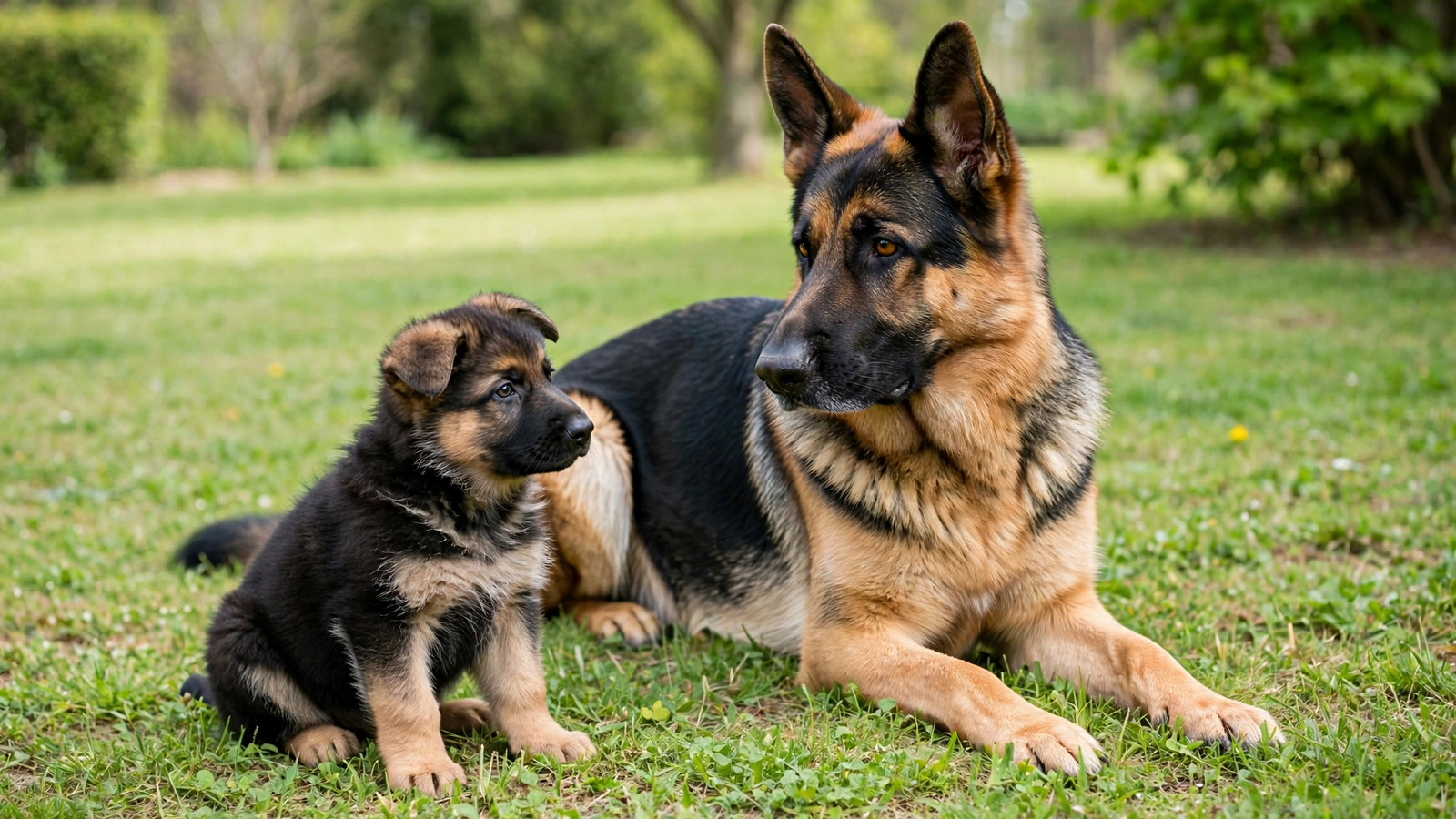
If your German Shepherd puppy seems to double in size every time you blink, you are not imagining it. A male puppy can go from roughly 16 to 20 pounds at 8 weeks to somewhere near 70 pounds by his first birthday. Then, just when you expect the growth to stop, he keeps getting wider. His chest deepens. His head broadens.
So when does it actually end? German Shepherds stop growing in height between 12 and 18 months, but most are not fully grown until age 2 to 3. Height finishes first. Weight and muscle come next. Mental maturity arrives last.
The short answer: three clocks, not one
A Shepherd does not stop growing all at once. Three things finish on three different schedules.
| What finishes | Typical age range | What you will notice |
|---|---|---|
| Height | 12 to 18 months | Shoulder height stops changing. The puppy stops looking taller every month. |
| Weight and muscle | 18 months to 3 years | Chest deepens, thighs thicken, neck and head broaden. Males usually take longer than females. |
| Full adult maturity | 2 to 3 years | Energy settles, focus improves, guarding instincts become steady rather than frantic. |
That split explains the classic 14-month-old Shepherd look: full height, narrow chest, big paws, and a body that still looks like it was assembled from spare parts. He is not underfed. He is mid-process.
Every range in this article is a typical range, not a pass-or-fail test. What matters is steady progress, a lean body condition, and a vet who has seen your dog grow.
German Shepherd growth chart: month by month
Use this chart as a rough map, not a report card. Compare the trend over months rather than panicking over one reading.
| Age | Male weight | Female weight | Male height | Female height |
|---|---|---|---|---|
| 2 months | 16 to 20 lb | 11 to 17 lb | 7 to 9 in | 6 to 9 in |
| 3 months | 22 to 30 lb | 17 to 26 lb | 9 to 11 in | 8 to 10 in |
| 4 months | 35 to 40 lb | 31 to 35 lb | 11 to 14 in | 10 to 12 in |
| 6 months | 49 to 57 lb | 44 to 49 lb | 16 to 18 in | 15 to 17 in |
| 9 months | 64 to 71 lb | 55 to 60 lb | 21 to 23 in | 19 to 21 in |
| 12 months | 71 to 75 lb | 60 to 64 lb | 22 to 24 in | 20 to 22 in |
| 18 months | 71 to 79 lb | 60 to 66 lb | 23 to 25 in | 21 to 22 in |
| 24 months | 71 to 84 lb | 62 to 66 lb | 23 to 25 in | 21 to 22 in |
| 36 months | 79 to 88 lb | 66 to 70 lb | 24 to 26 in | 22 to 24 in |
For the adult endpoint, the American Kennel Club puts males at 24 to 26 inches at the shoulder and up to 90 pounds, and females at 22 to 24 inches and up to 70 pounds. A dog who is 27 inches and lean is less of a concern than a dog who is 24 inches and carrying 15 extra pounds.
Notice the shape of the curve. The fastest growth happens in the first six months. After six months the pace slows a lot. From 12 months on, most of the change is muscle and chest, not height.
For a deeper look at weight across the whole first year, see our German Shepherd weight chart from puppy to adult.
Males vs females: who finishes first
Females usually finish first. Most females reach their adult height around 12 to 14 months and finish filling out by about age 2. Males often add a little height between 12 and 18 months and keep adding muscle until age 2.5 to 3. Adult males typically run 15 to 20 pounds heavier than adult females, with broader heads and thicker necks. Because males grow for longer, they spend more months in the fragile phase where bones are still developing, which makes the feeding and exercise rules below slightly more important for them.
What actually controls how big your Shepherd gets
1. Genetics sets the range
The single biggest factor is the parents. If both parents are 85-pound males and 70-pound females from large lines, the puppies will usually land near the top of the chart. If the parents are lean 65-pound working-line dogs, expect leaner, lighter adults. If you bought from a breeder, ask for the parents’ adult weights. That one number predicts adult size better than any chart. Genetics also decides proportions: some lines are taller and narrower, some are shorter and stockier.
2. Nutrition sets the pace, not the endpoint
Food does not decide how big a dog’s genetics allow him to be. It decides whether he gets there safely. A puppy fed too much, or fed a food with too much calcium, can grow too fast for his own skeleton. VCA Hospitals warns that large-breed puppies who grow too quickly are more likely to develop bone or joint abnormalities, and advises picking a food whose AAFCO statement says it is formulated for growing large or giant breed dogs.
The fix is boring and it works: a large-breed puppy formula, measured portions, no free-feeding a giant bowl all day, and no calcium supplements unless your vet tells you to add them. If you are unsure about portions, our dog calorie calculator gives you a starting number by weight and activity.
Recommended
Royal Canin German Shepherd Puppy Dry Dog Food
Breed-specific puppy formula designed for German Shepherd growth, with controlled mineral levels for steady bone development.
3. Spay and neuter timing can shift growth
This is the part most owners never hear about. Sex hormones help tell the growth plates at the ends of long bones when to close. When a dog is spayed or neutered, those hormones go away, and the growth plates can stay open longer, often leaving a slightly taller dog with longer legs.
That sounds harmless, but researchers have linked early spay and neuter in large breeds to a higher risk of joint disorders. In a UC Davis study that followed 1,170 German Shepherds, joint disorders were diagnosed in 21 percent of neutered males compared with 7 percent of intact males, and in 16 percent of spayed females compared with 5 percent of intact females. The same research group suggests waiting until at least 24 months before neutering a male German Shepherd.
That does not mean every Shepherd must stay intact until age 2. There are real reasons to spay or neuter earlier, including preventing unwanted litters and reducing the risk of some reproductive cancers. It does mean the decision deserves a real conversation with your vet, not a default appointment at 6 months.
4. Health problems can slow or distort growth
Intestinal parasites are the classic hidden brake on growth. A puppy with worms can eat well and still fall behind the chart, because the parasites take their share first. The pattern to watch is a sudden change: a puppy who was tracking the chart and then stalls for a month, loses weight, or starts limping after exercise needs a vet visit, not a bigger food bowl. Cornell University College of Veterinary Medicine notes that hip dysplasia is one of the most common causes of hind-leg lameness in young large-breed dogs.
Feeding a growing Shepherd without overdoing it
A growing puppy looks hungry all the time. He would happily eat twice what he needs. But a fat puppy is not a healthy puppy, and a puppy who grows too fast is not a puppy who ends up bigger.
Measure every meal. Eyeballing kibble is how portions creep up by 20 percent without anyone noticing. A kitchen scale is more accurate than a cup, and it takes ten seconds. Split the daily amount into three meals up to 6 months, then two meals after that.
Recommended
Etekcity Digital Kitchen & Food Scale
Weighing kibble beats scooping it. A scale keeps portions honest while your puppy is growing fast.
Keep treats under 10 percent of daily calories. Training a Shepherd puppy takes a lot of treats. That is fine. Just count them. Use small, pea-sized pieces, and subtract training treats from the meal portions.
Learn the rib test and use it weekly. Run your hands along your dog’s sides. You should feel ribs easily under a thin layer of fat, without pressing hard. Looked at from above, there should be a visible waist behind the ribs. If you cannot feel ribs, your dog is carrying too much weight for his frame, no matter what the chart says.
Exercise during the growth years
A growing Shepherd needs exercise. He just needs the right kind. The goal is steady muscle development without hammering joints that are still forming.
Short, frequent sessions beat one long slog. Several 15 to 30 minute walks a day, plus free play on soft ground, suit most puppies better than a single 90-minute hike. Free play is the best exercise there is at this age, because the puppy sets his own pace.
Hold off on the high-impact stuff until the growth plates close. That means no forced running on pavement, no repeated jumping in and out of a tall SUV, and no long hikes on hard ground for a puppy under 12 to 18 months. A folding ramp for the car cuts out one of the biggest daily impacts on young hips.
Swimming is the exception. It builds muscle with almost no joint impact, so short swims are one of the best workouts for a growing dog.
Recommended
PetSafe Happy Ride Telescoping Dog Ramp
Lets a growing puppy get in and out of the car without the repeated hard landing on developing joints.
The monthly weigh-in: a 10-minute routine that catches problems early
Charts are only useful if you actually track your dog against them. This routine takes ten minutes once a month.
Step 1: Weigh on the same scale, same time of day. Morning, before breakfast, after a bathroom break, is the most consistent. If your dog is too big to lift onto a home scale, weigh yourself, then weigh yourself holding him, and subtract.
Step 2: Measure height at the withers and do the rib test. Stand your dog square on a flat floor and measure straight down from the top of the shoulder blades. Then feel the ribs and look for a waist from above.
Step 3: Log the numbers and one photo. A notebook, a notes app, or a spreadsheet all work. Take one side-on photo in the same spot each month. Photos catch changes your eyes miss day to day.
Step 4: Compare the trend, not the single number. Is the weight moving in the same direction as the chart? Is the height still climbing, or has it leveled off? A puppy who jumps 15 pounds in a month, or stalls for two months in a row, is worth a vet call.
Step 5: Adjust food by the trend, in small steps. If weight is climbing too fast and ribs are getting hard to feel, cut the daily portion by about 10 percent and recheck in two weeks.
Monthly check checklist:
- Weight logged, same scale and time of day
- Height at withers measured and logged
- Rib test done, waist checked from above
- Any limping, stiffness, or trouble on stairs noted
- Next vet visit or vaccine due date confirmed
When growth looks off: red flags worth a vet visit
Most growth worries turn out to be normal variation. Three patterns deserve a prompt vet visit rather than a wait-and-see month: a puppy who stops gaining for two months in a row during the first year, or loses weight at any age; growth that is wildly uneven, such as front legs that look normal while back legs seem short, or joints that look swollen or angled oddly; and limping that lasts more than a day or two, stiffness after rest, or a refusal to jump or climb stairs. Panosteitis, the real “growing pains” condition, does cause shifting leg lameness in young large breeds and usually resolves. But hip and elbow dysplasia can look similar early on.
If something feels wrong, a vet visit is cheaper than a month of worrying. Bring your log.
Frequently asked questions
How big will my German Shepherd get?
Adult males typically reach 24 to 26 inches at the shoulder and 65 to 90 pounds. Adult females typically reach 22 to 24 inches and 50 to 70 pounds. The best predictor is the parents’ adult size.
Do German Shepherds grow after 1 year?
Yes, but mostly in width, not height. Most Shepherds reach close to full height by 12 to 18 months, then keep adding muscle, chest depth, and head width until age 2 to 3.
Why is my German Shepherd so small for his age?
Small variations are normal. Females run up to 20 pounds lighter than males, and working-line dogs are often leaner than show-line dogs. A puppy who is far below the chart, losing weight, or not gaining for two months should be checked for parasites or nutrition problems.
When should I switch my German Shepherd to adult food?
Most vets recommend staying on a large-breed puppy formula until 14 to 18 months, and some keep Shepherds on puppy food until 18 to 24 months. Do not switch based on height alone.
Can neutering change how tall my German Shepherd gets?
It can. Removing sex hormones before the growth plates close can delay closure, which can leave the dog slightly taller with longer legs. Research in large breeds links early spay and neuter to a higher risk of joint disorders, which is why many vets now recommend discussing timing rather than defaulting to 6 months.
At what age is a German Shepherd fully grown?
Most owners can treat 18 to 24 months as adult, and 2 to 3 years as fully mature. By then height has stopped, muscle has filled in, and the dog’s temperament has settled.
The bottom line
Your Shepherd will stop getting taller somewhere between 12 and 18 months. He will stop filling out somewhere between 2 and 3 years. The best thing you can do during the growth years is keep it steady: a large-breed puppy food in measured portions, exercise that builds muscle without pounding joints, a monthly weigh-in logged in one place, and a vet who sees the numbers.
This article is for information only and isn’t a substitute for your vet’s advice.
Sources: American Kennel Club, German Shepherd vs. Belgian Malinois size comparison; VCA Hospitals, Nutrition: General Feeding Guidelines for Dogs; Cornell University College of Veterinary Medicine, Canine Hip Dysplasia; VCA Hospitals, How to Choose the Right Puppy Food.
Leave a Reply