
Disclosure: Pets Life Time participates in affiliate programs. Product links in this article may earn us a commission at no extra cost to you — it helps keep our content free. Learn more
Picture this: your dog gains six pounds in three months, and you never fed him one extra scoop. Same scoops. Same feeding times. The only change was the bag of kibble.
Here is the catch. The old food had 342 calories per cup. The new one had 412. Two cups a day went from 684 calories to 824, an extra 140 a day, and six extra pounds over three months. No one was overfeeding. They were just measuring the wrong thing.
That is exactly why vets talk about calories instead of cups. Get the calorie number right for your dog, and everything else, portions, treats, food swaps, gets simple.
Why Calories Beat Cups Every Time
A “cup” of dog food is not a fixed unit of nutrition. Kibble calorie density typically runs anywhere from about 300 to 450 calories per cup. That means a cup of one food can pack nearly 50 percent more energy than a cup of another.
This is the single most common feeding mistake owners make: switching brands cup-for-cup and accidentally overfeeding or underfeeding for months. When you switch foods, the first thing to check is the kcal per cup on the new bag, then recalculate. Never assume the scoop size stays the same.
Thinking in calories also fixes the treat problem, the age problem, and the “my two dogs weigh the same but one is round and one is ripped” problem. One number, adjusted for the dog in front of you.
The Vet Formula, In Plain English
Veterinarians estimate daily calories in two steps. First, the Resting Energy Requirement (RER): the calories a dog burns doing absolutely nothing, just breathing and staying warm. For dogs between roughly 2 and 45 kg, the simplified math is:
RER = 30 x weight in kg + 70
Then you multiply by a factor for the dog’s real life, giving the Maintenance Energy Requirement (MER). Common factors: neutered adult 1.6, intact adult 1.8, inactive or obese-prone 1.2, weight loss 1.0, puppies 2.0 to 3.0, working dogs 2.0 to 5.0.
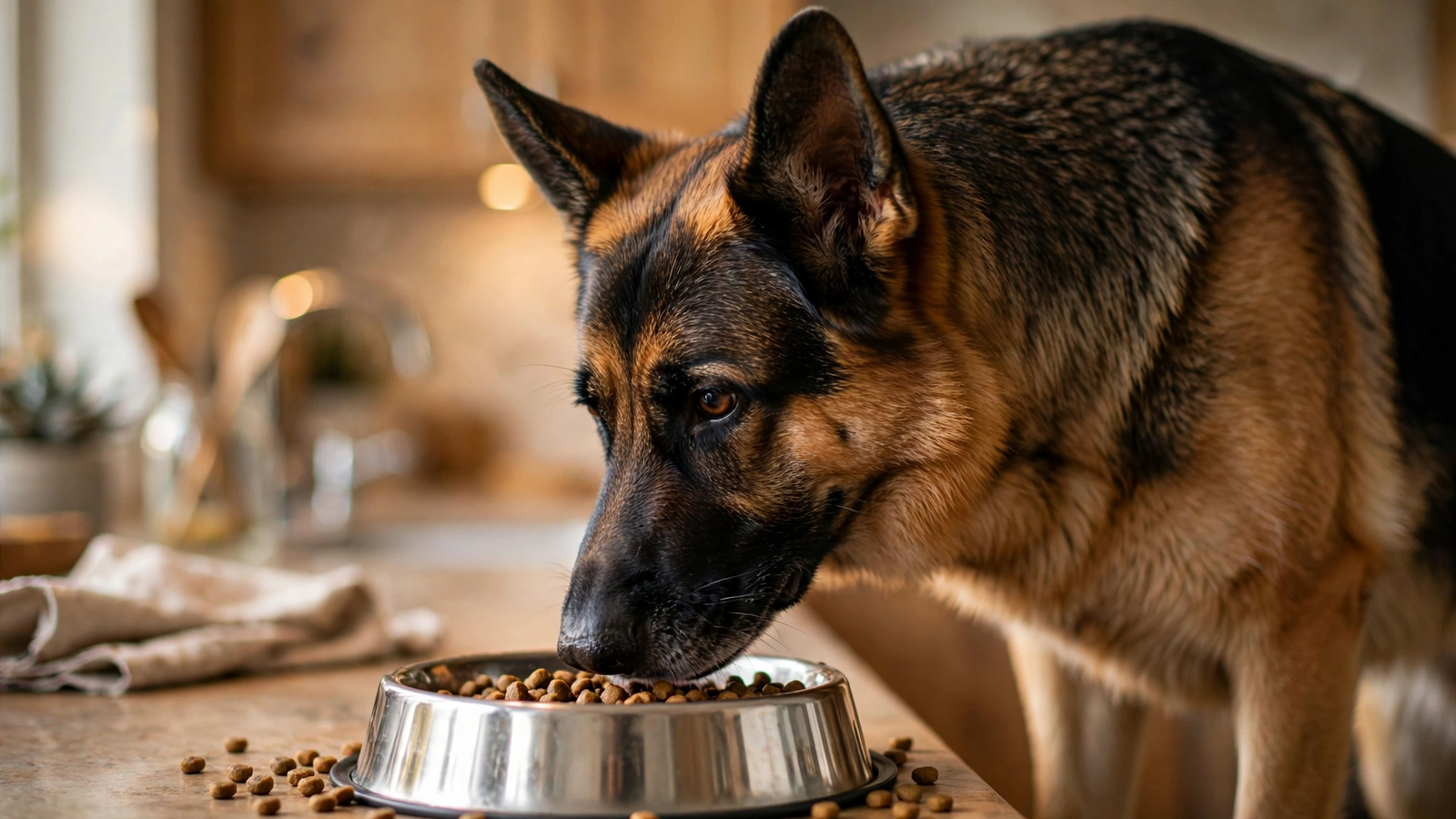
Let us run a real one. Take a 75-pound (34 kg) German Shepherd, neutered, moderately active:
- RER = 30 x 34 + 70 = 1,090 calories
- MER = 1,090 x 1.6 = about 1,744 calories per day
That is your starting point, not a prescription. The formula gets you in the right neighborhood. Your dog’s ribs and waist tell you whether to stay or adjust. Want to skip the math? Run your dog’s numbers through our free dog calorie calculator and it does this in seconds.
Recommended
Etekcity Digital Kitchen & Food Scale
Calorie math only works if your portions are accurate, and scoops are guesswork. A scale turns “about a cup” into an exact gram count.
Check Price on AmazonDaily Calorie Chart by Weight
This chart assumes a moderately active, neutered adult dog. Use the low end for couch-potato tendencies, the high end for dogs that never sit still.
| Dog’s weight | Calories per day (estimate) |
|---|---|
| 10 lb | 300 to 390 |
| 20 lb | 510 to 660 |
| 30 lb | 690 to 890 |
| 40 lb | 860 to 1,110 |
| 50 lb | 1,020 to 1,310 |
| 60 lb | 1,170 to 1,500 |
| 70 lb | 1,310 to 1,690 |
| 80 lb | 1,450 to 1,860 |
| 100 lb | 1,710 to 2,200 |
Remember these are starting points. Two 60-pound dogs can easily need 300 calories apart if one naps all day and the other runs trails with you.
What Pushes the Number Up or Down
Weight sets the baseline, but four things move the needle more than most owners expect.
Activity level is the big one. A working dog doing search-and-rescue or herding can need double the calories of the same dog on a lazy week. Even a normal pet dog’s needs shift with the seasons. More long walks in spring? Portions probably creep up. Housebound through a rainy month? They should come down.
Spayed or neutered dogs need less. This surprises people. After spaying or neutering, metabolism typically slows and appetite often rises at the same time, a brutal combination for waistlines. Most fixed dogs land near the 1.6 factor; intact dogs often need closer to 1.8.
Age changes everything. Puppies burn calories like furnaces because they are building a whole skeleton and muscle system; they can need twice the calories per pound of an adult. Seniors go the other way: slower metabolism, creakier joints, less zooming. If your dog is entering the gray-muzzle years, check where they land with our dog age calculator and consider trimming portions 10 to 20 percent while watching body condition.
Breed and build matter at the margins. Muscle burns more energy than fat even at rest, so a lean, athletic dog of the same weight needs more than a soft one. This is also why feeding toward your dog’s ideal weight matters more than feeding toward the weight on the scale right now. If your dog is already carrying extra, learn how to tell if your dog is overweight and run the calorie math for the weight they should be.
Recommended
Outward Hound Portion Pacer
It drops into the bowl and slows down gulpers, so the carefully measured portion you calculated actually gets eaten at a sensible pace.
Check Price on AmazonThe Treats Trap
Almost nobody counts this part. Treats, dental chews, training rewards, the crust of your sandwich, all of it comes out of the same daily calorie budget. A large milk-bone style biscuit can run 100+ calories, which is a tenth of a big dog’s day and a third of a small dog’s.
The rule most veterinary nutritionists land on: treats should be no more than 10 percent of total daily calories. The American Kennel Club’s treat guide lays out the math, and Cornell’s veterinary nutrition team suggests capping non-meal calories at 10 to 15 percent, noting that the average dog in one study was actually getting about 20 percent of calories from scraps and extras. Nobody thinks they feed that much. Everyone does.
The fix is simple and free: set aside part of each meal’s kibble to use as training treats. Same calories, same balanced nutrition, and your dog thinks they hit the jackpot.
Turn the Number Into Actual Meals
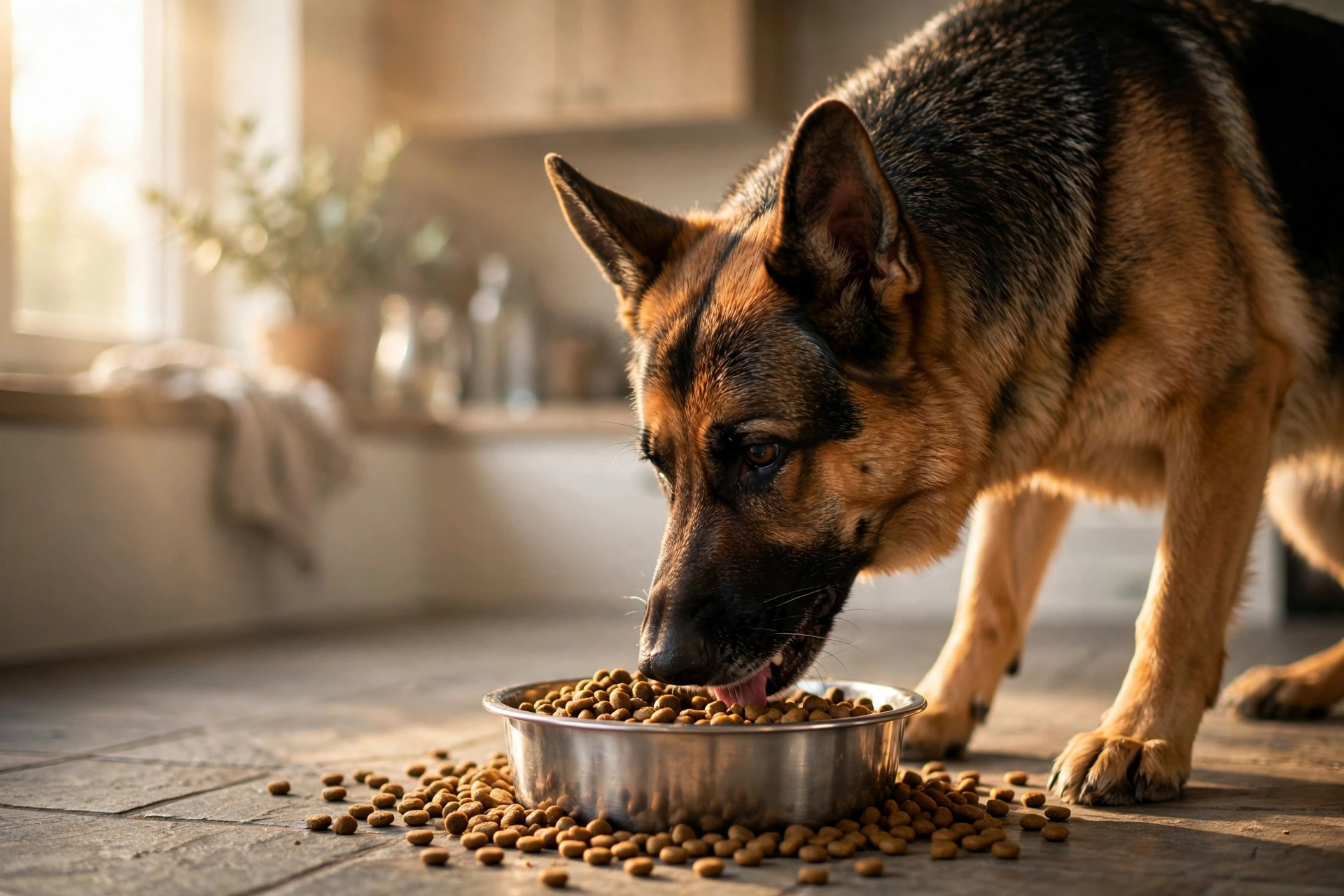
Once you have the daily calorie target, converting it to food takes one more step: check the kcal per cup (or per can) on your food’s label, usually in small print near the guaranteed analysis. Divide your daily target by that number and you get cups per day. Split that across two meals for most adult dogs.
Three practical rules make this stick:
- Weigh the food for a week. A “cup” scooped with a coffee mug can vary 20 percent from an actual 8-ounce measuring cup. A cheap kitchen scale removes the guesswork permanently.
- Compare with the bag’s feeding guide. VCA Hospitals notes that feeding guidelines on the package are a reasonable starting point for a healthy dog, but your vet can do an individualized energy calculation. If the bag says 3 cups and your calorie math says 2, trust the calorie math and watch the dog.
- Re-check every food change. Any new bag, new formula, or new treat brand means a new kcal number. Recalculate before you pour.
Recommended
PetSafe Healthy Pet Simply Feed Automatic Pet Feeder
Pre-programmed, pre-measured meals keep portions exact on days you can’t be home at feeding time, no eyeballing, no “just a little extra.”
Check Price on AmazonHow to Know You Got It Right
The formula and the chart get you close. Your dog’s body closes the deal. Every two to four weeks, run the hands-on check: ribs should be easy to feel under a thin fat layer but not visible, and there should be a visible waist when you look down from above.
If weight creeps up more than a couple of percent, trim portions by 10 to 15 percent and reassess in two weeks. If ribs start showing, add the same amount back. Small, boring adjustments beat dramatic diet overhauls every time. And for dogs with medical conditions, thyroid issues, diabetes, or anything that messes with metabolism, this is a conversation with your vet, not a chart.
For a full walkthrough of converting calories into scoops for your specific food, see our feeding chart by weight.
Quick Answers
Are the feeding guides on food bags enough?
They are a fine starting point for an average dog, but “average” does a lot of work in that sentence. Bags cannot know your dog’s activity level, metabolism, or treat habits. Use the guide as a sanity check against your calorie math, not the other way around.
How many calories does a German Shepherd need?
A 75-pound adult German Shepherd with moderate activity needs roughly 1,700 to 1,800 calories a day. Active or working Shepherds can push past 2,000. Neutered couch-loving adults may need closer to 1,400. Start with the formula, then adjust by body condition.
Do puppies really need more calories per pound?
Yes, significantly. Growing puppies can need two to three times the RER, which is why puppy formulas are more calorie-dense and why puppies eat three to four smaller meals a day. Switch to adult portions gradually as growth slows.
This article is for information only and isn’t a substitute for your vet’s advice.

Leave a Reply