
Disclosure: Pets Life Time participates in affiliate programs. Product links in this article may earn us a commission at no extra cost to you — it helps keep our content free. Learn more
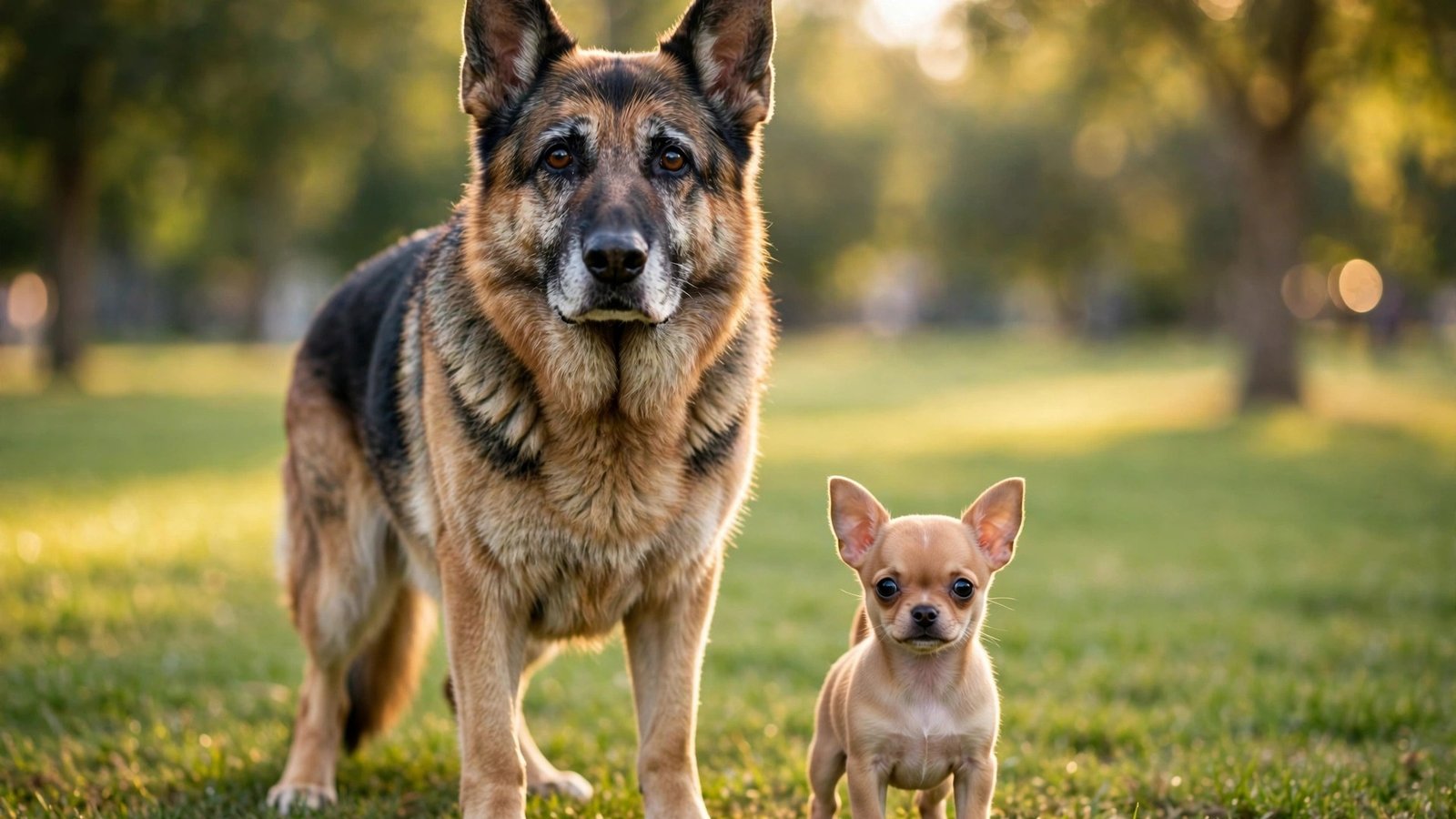
Two 8-year-old dogs meet at the park. One is a Chihuahua, still bouncing around like a teenager. The other is a German Shepherd who groans a little getting up from his nap.
Same age on paper. Different decades in dog time.
That’s the piece the old “multiply by 7” rule never explained. That 8-year-old Chihuahua is roughly 48 in human years. The German Shepherd is closer to 55. By age 13, the gap turns into a chasm: 68 versus 82.
Size changes everything about how dogs age. Below is the chart, plus why the gap exists and what to do with the number.
The Dog Age Chart: Small vs Large Breeds
Find your dog’s age on the left, slide across to their size column. That number is the rough human equivalent: a guide, not a lab result.
| Dog’s Age | Small (under 20 lbs) |
Medium (21-50 lbs) |
Large (51+ lbs) |
|---|---|---|---|
| 1 year | 15 | 15 | 15 |
| 2 years | 24 | 24 | 24 |
| 3 years | 28 | 28 | 28 |
| 4 years | 32 | 32 | 32 |
| 5 years | 36 | 36 | 36 |
| 6 years | 40 | 42 | 45 |
| 7 years | 44 | 47 | 50 |
| 8 years | 48 | 51 | 55 |
| 9 years | 52 | 56 | 61 |
| 10 years | 56 | 60 | 66 |
| 11 years | 60 | 65 | 72 |
| 12 years | 64 | 69 | 77 |
| 13 years | 68 | 74 | 82 |
| 14 years | 72 | 78 | 88 |
| 15 years | 76 | 83 | 93 |
| 16 years | 80 | 87 | 99 |
Notice the pattern. Through age 5, size barely matters. Then the columns split and never come back together: a 15-year-old small dog is a spry 76, a 15-year-old large dog is 93. For a more precise number based on breed size, try our free dog age calculator.
Why the 7-Year Rule Fails
Somebody back in the 1950s looked at two numbers: average human lifespan (about 70) and average dog lifespan (about 10). Divide, and you get 7. That was the whole scientific method.
The ratio stuck for decades because it was simple, not because it was right. The American Veterinary Medical Association’s actual guideline tells a very different story: year one equals about 15 human years, year two adds roughly 9, and from there it depends on size. The AKC has a solid breakdown of how these numbers were really calculated, and the history is messier than most people think. If you’ve been telling people your 6-year-old Lab is 42, update your math: he’s closer to 45.
Why Big Dogs Age Faster Than Small Ones
Scientists still argue about the why, and the honest answer is: nobody fully knows.
Here’s what makes it weird. Giant-breed puppies grow faster than small ones: a Great Dane puppy packs on weight at a rate that would alarm a pediatrician. Then, around mid-life, the fast growth seems to catch up. The Dane is gray-faced at 5; the Chihuahua the same age is in its prime.
The leading theory points at growth hormones: the same signals that build a 120-pound body may burn the candle faster on the other end. In 2019, UC San Diego researchers measured DNA methylation, the chemical changes to DNA that track biological age, across 104 Labrador Retrievers. Their formula matched real biology better than the old chart ever did, though it was built on one breed, so take it as a data point, not gospel.
Cornell’s CHAMP program studies exactly this: mobility, nutrition, and pain management to keep aging dogs moving well. You can read about their aging-dog research here.
Whatever the mechanism, the takeaway is simple: size is the single biggest predictor of how fast a dog ages. Bigger body, shorter fuse.
Recommended
Nutramax Cosequin Maximum Strength Joint Supplement
Large breeds feel their age in their joints first. Glucosamine and chondroitin are the standard vet-recommended daily habit for aging big dogs.
Check Price on AmazonWhat the Gap Means at Each Life Stage
Charts are fun. But the number only matters if it changes what you do.
Small dogs (under ~20 lbs) age slowly after year five. A 12-year-old Dachshund is 64 in human years: solidly middle-aged, with a good chance of seeing 15 or more. Large dogs (51+ lbs) cross into senior territory years earlier. A German Shepherd at 12 is 77: same number of birthdays, completely different meaning, which is when joint support, adjusted exercise, and senior bloodwork start mattering.
The senior threshold is where the gap bites hardest. VCA Hospitals frames it the way vets think: dogs are generally senior once they pass 75% of their expected lifespan. That’s a giant breed at 5 or 6, a German Shepherd around 7, a small breed at 10 to 12. Their guide to helping senior dogs age gracefully is worth a read. Senior isn’t an age. It’s a fraction of a lifespan.
Where German Shepherds Land on the Chart
German Shepherds sit squarely in the Large column: most adults run 51 to 90+ pounds. Look up age 8 and you’re at 55 human years. That’s usually the age owners notice the first real changes: slower to rise in the morning, gray creeping into the muzzle, hips a little creaky after long walks.
Two things worth knowing about this breed. Shepherds are considered senior around 6 or 7, earlier than most owners expect, and their average lifespan runs 9 to 13 years. That’s respectable for a large breed but short next to a small dog’s. I wrote a deeper breakdown of how long German Shepherds live and what actually moves the needle if you want the full picture.
The mistake I see most often: owners of 7-year-old Shepherds still treating them like middle-aged dogs. At 7, your Shepherd is 50. Would you skip a doctor’s visit at 50? That’s the mindset shift the chart is really for.
Recommended
Furhaven Orthopedic Dog Bed (Large)
An aging large breed sleeps 14+ hours a day. Supportive memory foam takes real pressure off hips and elbows that are already working overtime.
Check Price on AmazonHow to Use Your Dog’s Human Age
1. Vet visits
A large-breed dog that’s 60 in human years deserves senior bloodwork and checkups at least yearly. Senior visits catch kidney, thyroid, and dental problems early, when they’re cheapest to manage. Large breeds: start the senior schedule at 6 or 7. Small breeds can usually wait until 9 or 10.
2. Food
Metabolism slows as dogs age, and senior formulas cut calories while adding joint support and fiber. Big breeds usually switch around 6 or 7; small breeds around 10. As activity drops, recheck portions rather than guessing: our dog calorie calculator runs the math on what an older dog actually needs.
Recommended
Blue Buffalo Life Protection Formula Senior Large Breed Dog Food
Controlled calories, glucosamine for joints, no fillers. The right switch once your big dog crosses the senior threshold.
Check Price on Amazon3. Exercise and recovery
Your dog isn’t being lazy: their body genuinely recovers slower. Shorter, more frequent walks beat one long weekend hike, and ramps plus grippy rugs save older joints from stairs. Hesitating at the car or taking longer to warm up after naps is the body telling you the chart is real.
Common Questions
Is this dog age chart accurate?
It’s an estimate based on population averages, and individual dogs vary with genetics, weight, and care. An overweight dog will often age faster than the chart suggests; a fit one may beat it. Vets still use size-based charts because they’re far closer than the 7-year rule ever was.
At what age is a German Shepherd considered a senior?
Around 6 to 7 years old, which maps to roughly 45 to 50 human years. That’s when most vets recommend switching to senior food and scheduling senior wellness visits.
Do mixed-breed dogs age differently?
Mostly they land wherever their adult size puts them on the chart. Vets do note that mixed breeds often outlive purebreds of similar size, probably thanks to a wider gene pool. Size still dominates the math.
This article is for information only and isn’t a substitute for your vet’s advice.

Leave a Reply